
Artificial Intelligence is evolving rapidly, and tools like ChatGPT have already changed how people search, write, learn, and work online.
Now, India is also stepping into the AI space with BharatGPT — an initiative focused on building AI solutions better suited for Indian users and regional languages.
As interest in AI continues to grow, many people are now asking:
- Is BharatGPT similar to ChatGPT?
- What’s the difference between them?
- Which AI platform is better for Indian users?
- Can BharatGPT compete with global AI models?
The truth is, both platforms are designed with different goals in mind.
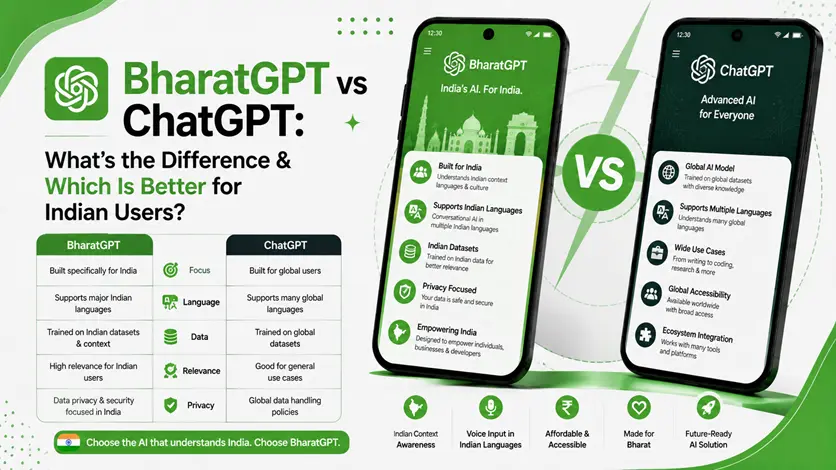
ChatGPT focuses on global AI capabilities, while BharatGPT aims to improve AI accessibility for India’s diverse digital ecosystem.
👉 If you’re new to BharatGPT, you can first explore what BharatGPT is, its features, use cases & future potential to understand its background and goals.
In this guide, we’ll compare BharatGPT and ChatGPT in simple terms and understand which one may be more useful for Indian users in different situations.
What Is ChatGPT?
ChatGPT is a globally popular AI chatbot developed to assist users with:
- Writing
- Research
- Productivity
- Learning
- Coding
- Conversations
It can generate human-like responses and help with a wide range of tasks across multiple industries.
Today, ChatGPT is widely used by:
- Students
- Professionals
- Content creators
- Businesses
- Developers
👉 If you use AI tools regularly, you can also explore the best AI apps for Android (work smarter, save time & boost productivity).
What Is BharatGPT?
BharatGPT is an India-focused AI initiative designed to improve AI accessibility for Indian users, especially in regional languages.
Its goal is to create AI systems that better support:
- Indian languages
- Local communication
- Regional use cases
- India’s growing digital ecosystem
Unlike many global AI systems that primarily focus on English, BharatGPT aims to improve multilingual AI experiences for Indian users.
BharatGPT vs ChatGPT — Key Differences
🌐 1. Language FocusChatGPT
- Strong English support
- Supports multiple international languages
- Optimized for global users
🇮🇳 BharatGPT
- Stronger focus on Indian languages
- Designed for multilingual Indian communication
- Aims to improve accessibility for regional users
🎯 Why This Matters
India has millions of users who prefer:
- Hindi
- Tamil
- Bengali
- Telugu
- Marathi
- Other regional languages
Better regional language support could make AI more useful for a larger audience.
2. Primary Purpose
🤖 ChatGPT
Focused on:
- Global productivity
- AI conversations
- Content generation
- Research and learning
🇮🇳 BharatGPT
Focused more on:
- Indian digital use cases
- Local language communication
- AI accessibility within India
👉 BharatGPT may become more useful for localized applications in the future.
3. Productivity & Writing Features
🤖 ChatGPT
Currently stronger for:
- Content writing
- Email drafting
- Brainstorming
- Research assistance
- Coding help
👉 If you frequently create content, you can also explore the best AI writing apps for Android (content, notes & emails).
🇮🇳 BharatGPT
Potentially stronger for:
- Local-language communication
- India-focused AI services
- Educational and regional support systems
4. Education & Learning
🤖 ChatGPT
Widely used globally for:
- Study help
- Research
- Summaries
- Learning assistance
🇮🇳 BharatGPT
Could become especially useful for:
- Regional-language education
- Localized learning tools
- India-focused educational support
👉 Students can also explore the best free AI tools for students (study smarter).
5. Ecosystem Integration
🤖 ChatGPT
Works across:
- International platforms
- Productivity tools
- Global workflows
🇮🇳 BharatGPT
May focus more on:
- Indian apps
- Local digital services
- Regional platforms
- India-specific integrations
Can BharatGPT Replace ChatGPT?
At the moment, both platforms are designed for different purposes.
🤖 ChatGPT
Currently stronger in:
- Advanced AI conversations
- Global productivity
- Content generation
- Broad AI capabilities
🇮🇳 BharatGPT
May become stronger in:
- Indian language support
- Regional accessibility
- India-focused AI solutions
👉 Instead of direct competition, both may serve different user needs.
Which One Is Better for Indian Users?
The answer depends on how you use AI.
✅ Choose ChatGPT If You Want:
- Advanced AI conversations
- Content writing
- Productivity assistance
- Global AI tools
✅ Choose BharatGPT If You Want:
- Better Indian language support
- Regional communication tools
- Localized AI experiences
- India-focused AI ecosystem
Future Potential of BharatGPT
BharatGPT could become important because India has:
- A massive smartphone user base
- Growing internet adoption
- Increasing demand for AI tools
- Strong need for regional-language AI support
If developed successfully, BharatGPT could help bring AI technology to millions of users who are currently underserved by global AI platforms.
Challenges BharatGPT May Face
Like any AI platform, BharatGPT may face challenges such as:
- AI training complexity
- Competition with global AI companies
- Language accuracy improvements
- Infrastructure scaling
- User adoption
👉 Building a strong AI ecosystem takes time and continuous development.
Build a Smarter AI Workflow
AI platforms become much more useful when combined with productivity tools and workflows.
👉 To automate repetitive tasks, you can explore the best Android automation apps (save time with smart workflows).
👉 You can also explore the best AI voice assistant apps for Android (beyond Google Assistant) for smarter AI interaction on your phone.
Final Thoughts
Both BharatGPT and ChatGPT represent important parts of the future of artificial intelligence.
👉 ChatGPT currently leads in global AI capabilities and productivity-focused features.
👉 BharatGPT, on the other hand, has the potential to make AI more accessible and useful for India’s diverse linguistic and digital landscape.
Rather than thinking about them as direct rivals, it’s better to understand that they may serve different audiences and use cases.
As AI technology continues to evolve, users will likely benefit from having both global AI systems and localized AI solutions available.